

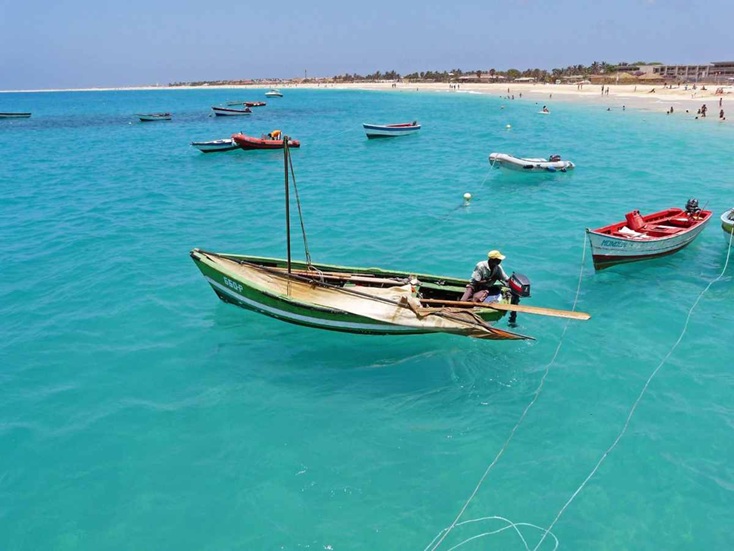
Boa Vista, one of the eastern islands of the Cape Verde archipelago, occupies a distinctive place in the geography of the Atlantic. Situated roughly 500 kilometers off the coast of West Africa, the island is characterized by wide coastal plains, modest volcanic elevations, and an atmosphere of remarkable spatial openness. Unlike many island destinations where dense development dominates the shoreline, Boa Vista remains defined by natural forces—persistent winds, shifting sand, and the steady motion of the ocean. These elements have shaped a landscape that feels both austere and expansive, attracting travelers interested not only in relaxation but also in environments where natural processes remain visibly active.
Vast Beaches and Uninterrupted Horizons
The island’s coastline is its most immediately striking feature. Dozens of kilometers of sandy beaches extend along the Atlantic, often without significant interruption by buildings or infrastructure. Praia de Santa Mónica, frequently cited among the most impressive beaches in the region, illustrates the scale of Boa Vista’s coastal environment. Its pale sand and powerful surf create a scene of remarkable simplicity: water, wind, and horizon. In contrast to tropical islands dominated by dense vegetation, Boa Vista’s terrain reveals an unusual blend of marine and desert characteristics. The influence of Saharan dust and wind patterns contributes to the formation of dunes that migrate slowly across the island’s interior, reinforcing the sense of a landscape constantly reshaped by natural forces.
Climate and the Atlantic Trade Winds
Boa Vista’s climate plays a crucial role in defining both its ecology and its appeal to visitors. The island experiences a warm, dry climate moderated by consistent Atlantic trade winds that circulate throughout much of the year. These winds help maintain relatively stable temperatures and prevent the intense humidity typical of equatorial environments. At the same time, they create ideal conditions for water sports such as windsurfing and kitesurfing, activities that have gradually become associated with the island’s tourism profile. Even for visitors who do not participate in such pursuits, the constant movement of air contributes to the island’s sensory character—salt carried on the breeze, the sound of waves rolling steadily onto shore, and the visibility of dunes shifting subtly over time.
Tourism in Balance with the Landscape
Over the past two decades, Boa Vista has experienced steady growth in tourism, yet its development remains more contained than that of many coastal destinations. Accommodation and visitor facilities tend to be concentrated in specific coastal zones, leaving large areas of the island relatively untouched. Many travelers stay in an all inclusive resort in Cape Verde, a model that allows visitors to access beaches and coastal activities while keeping tourism infrastructure largely confined to designated areas. When carefully managed, this approach can help preserve the island’s broader landscape by limiting dispersed construction and maintaining the visual continuity of the coastline. As a result, Boa Vista retains a sense of openness that is increasingly rare in popular island destinations.
Cultural Influences and Island Life
Beyond its physical environment, Boa Vista reflects the cultural complexity typical of the Cape Verde archipelago. The island’s main town, Sal Rei, serves as both a modest administrative center and a reminder of the region’s historical connections. Cape Verde’s past as a maritime crossroads between Africa, Europe, and the Americas is visible in local architecture, cuisine, and music. Fishing remains an important part of everyday life, and colorful boats lining the harbor illustrate the continuing relationship between residents and the surrounding ocean. Cultural expressions—from morna and coladeira music to local culinary traditions—offer insight into a society shaped by migration, trade, and the enduring influence of the sea.
The Appeal of Space, Silence, and Simplicity
What ultimately distinguishes Boa Vista from many other island destinations is the scale and quietness of its environment. Rather than offering dense clusters of attractions or elaborate entertainment districts, the island provides something increasingly rare: uninterrupted space. Wide beaches, open skies, and sparsely populated landscapes create an atmosphere that encourages reflection and unhurried exploration. Visitors often find that the experience of Boa Vista is defined less by scheduled activities than by the gradual immersion in its rhythms—long walks along wind-swept beaches, the steady movement of the Atlantic, and sunsets that unfold across an unobstructed horizon. In this sense, Boa Vista’s value lies not only in its scenery but also in its ability to preserve a landscape where natural simplicity remains central.
